Which pools will stay open?

By Dan Brazil, Head of UK Sales, Lynxight · 20 November 2026
Every fortnight, another public pool closes. Funding will save some, but not most. The rest will have to prove they're worth keeping, and right now most can't. At best, their booking systems show who paid, not how the water was actually used. Here's how forward-thinking operators are using new technology to close that gap.
The headline everyone is reacting to
It's been a busy week for swimming in the news. Last Friday, GB News published a stark picture of UK swimming provision. More than 500 public pools were lost between 2010 and 2025, according to the GMB union, and more than 1,200 are past their expected lifespan. Running one costs between £500,000 and £1.5 million a year. Within days, ukactive, PWTAG and others were sharing it.
On Monday came news of Andy Burnham's fund to rebuild outdoor pools. On Wednesday, London's deputy mayor, one of an estimated 700,000 Londoners who can't swim, showed off his first lengths as City Hall launched a £5 million swimming programme. Every time I open my newsfeed or scroll my FYP this week, there's another story about learning to swim.
None of it surprised me. It's what I heard all day at the Freeflow Swim Conference, where my colleague David Springthorpe, our UK Customer Engagement Lead, sat on the panel about making pools productive.
Why it matters beyond the balance sheet
About 80% of people in the UK learn to swim in a public pool, according to GLL. In 2023/24, around 30% of Year 7 pupils couldn't swim 25 metres (Sport England), and GB News notes that in 2023 there were 12,000 vacancies for swimming teachers, with around 600,000 children missing out on lessons. Swimming bodies have warned that closures push more young people towards open water on hot days.
Funding will help. It won't run your pool
The government has committed £400 million to sports facilities, and it's good to see new money for lidos and London's waterways. But much of it is for outdoor and open water, and so far, Swim England points out, none of the £400 million has reached pools. Capital funding builds and refurbishes. It doesn't cover the running costs of the indoor pool down the road, which teaches children to swim all year and loses money every week.
Smarter planning, powered by AI vision
This month David and I spent an hour with Emma Kuwertz, National Swim Manager at Nuffield Health, setting a baseline ahead of the forthcoming Lynxight trial at three of their sites. In that hour, their timetable, prices and revenue became a working model of the swim school.
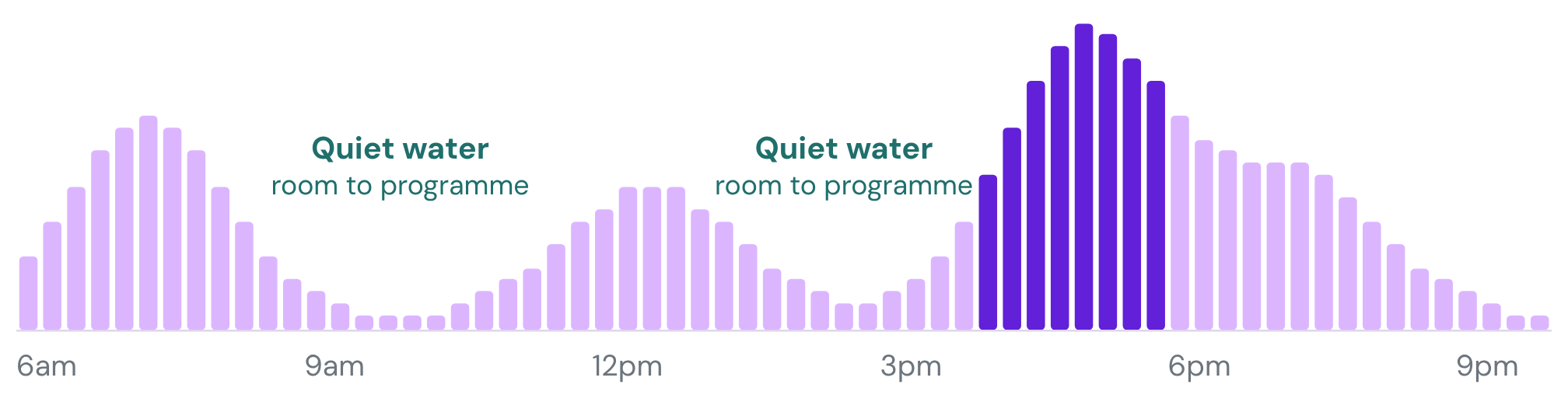
After school was already busy; the room to grow sat in daytime and weekend slots. Whether a class filled depended more on when it ran than on who taught it, and because a beginner needs only about five metres of water, two or three beginner classes could share the lane one class takes today. What the model can't show is what happens in the water day to day. With regional swim leads covering several sites, this trial will provide the visibility needed to better understand how pool space is being used across Nuffield's clubs and identify opportunities to maximise capacity while balancing the needs of both members and swim schools. As Emma put it:
The timetable tells us how our pools should be used. This trial will give us the data to understand how pool space is being used across our sites, so we can make informed decisions, identify opportunities and ensure we're making the best use of our water. The benefit is that we can create a better experience for members while supporting the continued growth of our swim schools.
By giving regional swim leads access to this data, they can make faster, more informed decisions, identify growth opportunities and balance swim school demand with member experience, rather than relying on assumptions or anecdotal feedback. Ultimately, this gives our teams a significant time-saving tool, allowing them to spend less time gathering information and more time using meaningful data to drive decisions, support sustainable growth and deliver the best outcomes for both members and swim schools.Emma KuwertzNational Swim Manager, Nuffield Health
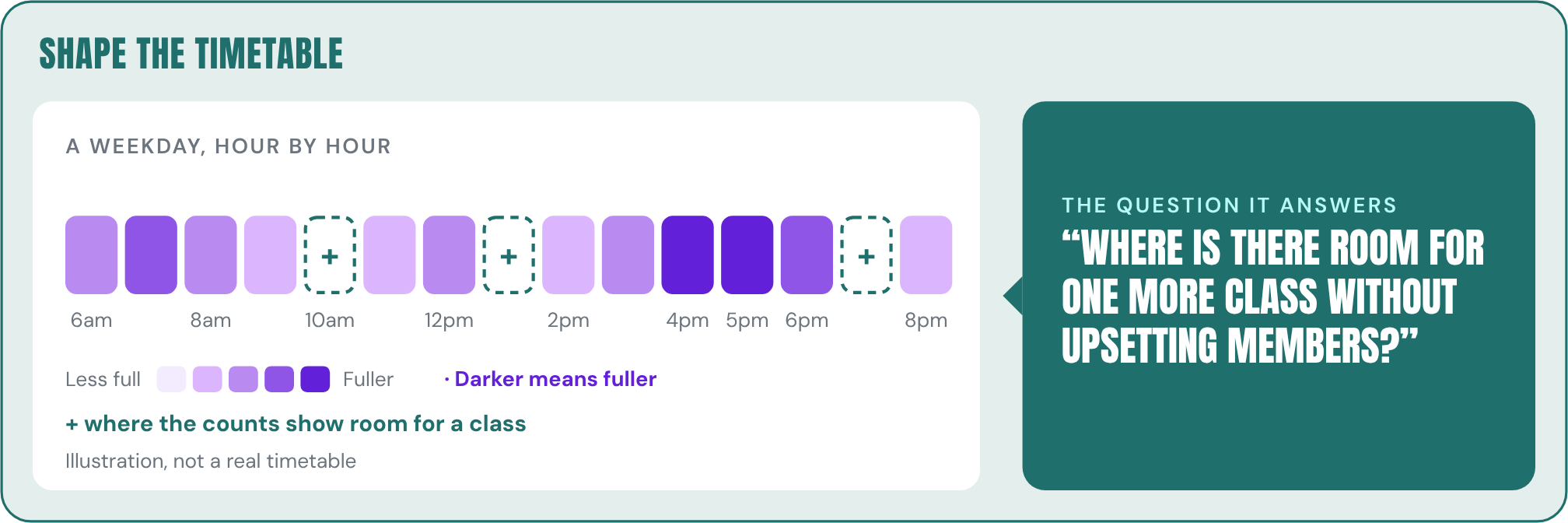
Chloe Efford, Aquatic Development Manager at Horizon Leisure, sat on that same Freeflow panel. Since then we've run a business case design session with Horizon. Rather than staffing or headcount, the case focuses on swim school productivity: how many more juniors would cover the investment, and when it pays back. Here's what Chloe made of the business case, and of the data:
I don't think it could have been much clearer... that document's going to save me a lot of work.
The data for me is definitely the number one aspect of it... This can influence a whole number of programmes, timetables, opportunities, growth, so many areas.Chloe EffordAquatic Development Manager, Horizon Leisure
The blind spot: booked versus happening
A booking is not a swim. As David put it at Freeflow, if a session is booked for an hour but people are only in the water for 40 minutes, "you've got a productive pool for 40 minutes and a gap for 20".
You can test this without any technology. Pick one session this week, count heads in the water every ten minutes and set the result against the booking sheet. The gap between the two is your blind spot.
Timetables used to be a visual grid of who had which lane, and when. Today many are long lists of session types that drift into slow, medium and fast lanes and long stretches of "general swim" aimed at everyone and therefore no one. You can't programme a gap you can't see.
I hear the same story from swim teams. They want more lessons in the quiet water, and the general manager pushes back: we're full, and our members won't like it. Without evidence, the conversation ends there. With a count of how many people are actually in the water, the swim team can show that extra lessons won't touch the lanes members use.

The missing link
Closing that gap is where we help, and it starts with safety, because the cameras that watch over swimmers also measure how the water is used. There are three layers, adding up to safer pools, happier swims and the evidence that a pool is worth keeping.
Risk mitigation: a safer pool, every minute it's open
The lifeguard stays the primary control; the technology is an extra layer behind them. Overhead cameras are designed to detect a swimmer in distress, submersion, overcrowding and unauthorised use, alerting lifeguards on their Smartwatch, with a monitor at reception. Every alert is logged with its response time, so debriefs and compliance rest on evidence, not memory.
Operational intelligence: find the gaps in the water
The same system counts swimmers by pool and zone, hour by hour. Set that against the timetable, and you see the lane that is full on paper and half empty in the water. Those are the gaps you can programme: more lessons and school swimming, aqua therapy and rehab, water confidence for nervous adults, sessions for people who will never swim lengths. And because every count is kept, the past becomes a guide to the future: knowing how the water was used this term helps you predict demand for the next. The system can even free lifeguards to try a new approach to customer engagement. There's more to a swimming pool than swimming.
Organisational visibility: one picture across every site
For multi-site operators, the real value comes from enterprise data: the same measures, standardised across every pool. Through our API, it can connect to the systems you already run, from bookings and membership to swim school platforms such as CoursePro. It's part of a wider shift: Gladstone's new Nova platform, for example, uses AI to help operators make decisions in real time across the business. Lynxight adds the part those systems can't see: what's happening in the water. Put sites side by side, see what the fullest pools do differently and take it to the rest. As David told the Freeflow audience, "Build the baseline first, and a whole new world opens up."

The answer is in the water
No timetable will mend a roof or settle an energy bill. But when a council, a funder or a board has to choose, the question underneath is the same: is this water being used? No council will spend taxpayers' money replacing a pool its own figures say is half empty.
The answer that carries weight is how the water is used: how many people swam, when, and what they were doing. For most pools, some of next year's growth is already there, in water that is heated, supervised and booked but not used. Emma's aim is simple: "getting more swimmers swimming is the biggest goal that we have". A productive pool is a profitable pool.

If you're curious what your own timetable is hiding, start with the simple head count test. To go further, join us for a Business Case Design Session: an hour on your own figures, built live in the scenario model above, becomes a plan you can take to your board. The thinking behind it is in our white paper, The Value-Driven Business Case.